The difference between a beginner playing a backbeat and Bernard Purdie playing the same backbeat is mostly ghost notes — the barely-audible snare hits between the loud ones that turn a metronomic groove into something that breathes.
What counts as a ghost note?
Technically: a snare hit played at very low velocity (typically 15–40 on a MIDI 0–127 scale) compared to the loud "accent" snare on beats 2 and 4.
Musically: it's the texture. Listen to "Cold Sweat" (Clyde Stubblefield), anything off "Aja" (Steve Gadd), or modern players like Anika Nilles — the loud snare hits are 20% of the part; the ghost notes are 80% of the feel.
Why detection is hard
Three problems compound:
- Low signal-to-noise. Ghost notes can be quieter than the bleed from the hi-hat mic.
- Time-resolution. They land on sixteenth-note and even thirty-second-note subdivisions where the quantizer wants to round them away.
- Confusion with rim/brush sounds. A model can mistake a soft ghost for a rim click or a stick-on-snare brush.
How GrooveSheet handles it
Our drum worker (ADTOF) outputs an onset list with per-onset confidence scores. After detection we run a velocity normalization pass: we look at the distribution of confidence values across the track and map them to a velocity range. The accented snare on 2 and 4 sets the upper bound; the noise floor sets the lower bound.
You can then control which low-velocity events make it into the final score via a ghost-note sensitivity slider:
- Low sensitivity. Only confident, mid-velocity-and-above events. Clean score, easy to read, loses subtle feel.
- Default. Includes ghosts down to ~velocity 25. Good balance for most pop/rock/funk.
- High sensitivity. Down to velocity 10. Captures everything including faint bleed — readable only if you're already a competent transcriber.
When to crank it up
- Funk, neo-soul, R&B, hip-hop drum samples — the ghost notes are the part.
- Studying a specific drummer's vocabulary (transcribing for educational purposes).
When to dial it back
- Charts for live performance. A drummer reading at tempo doesn't need every micro-event.
- Drum-machine-style tracks where ghosts would be machine noise, not intent.
How to read the output
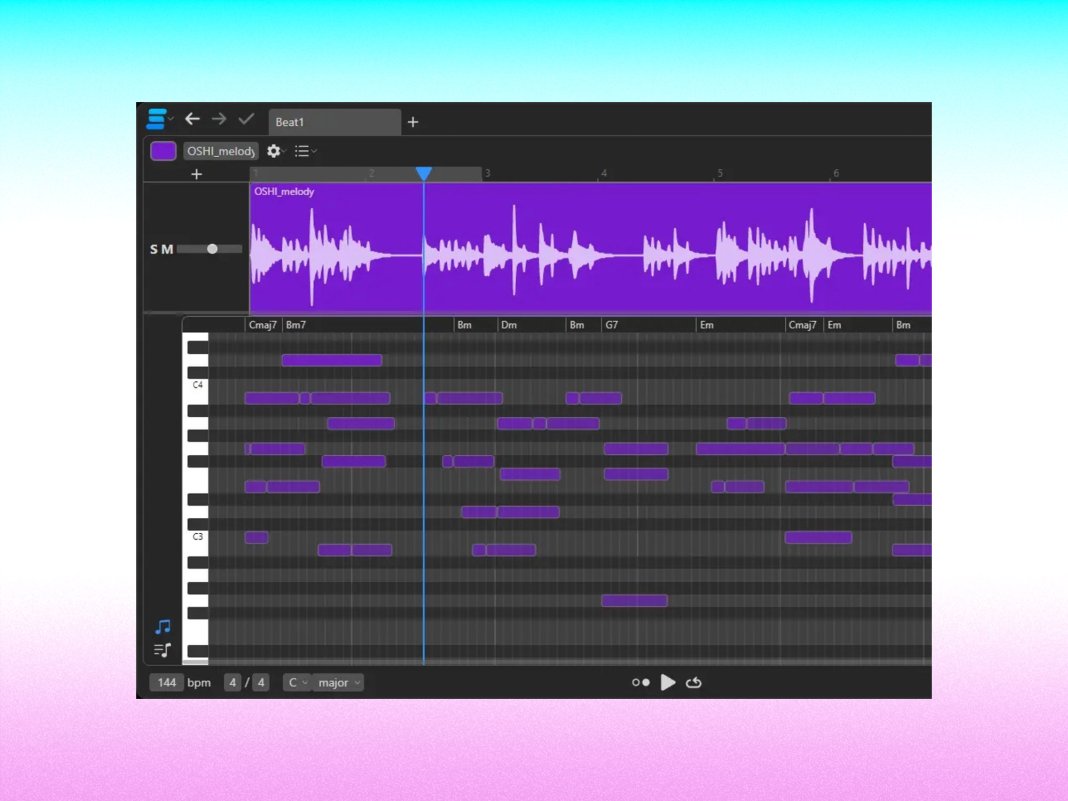
In MusicXML and PDF output, ghost notes appear with parentheses around the notehead — the standard convention. In MIDI, they appear as low-velocity hits, which any DAW will play back with the correct dynamics.
The slider isn't a "be more accurate" knob. It's a "match my use case" knob.