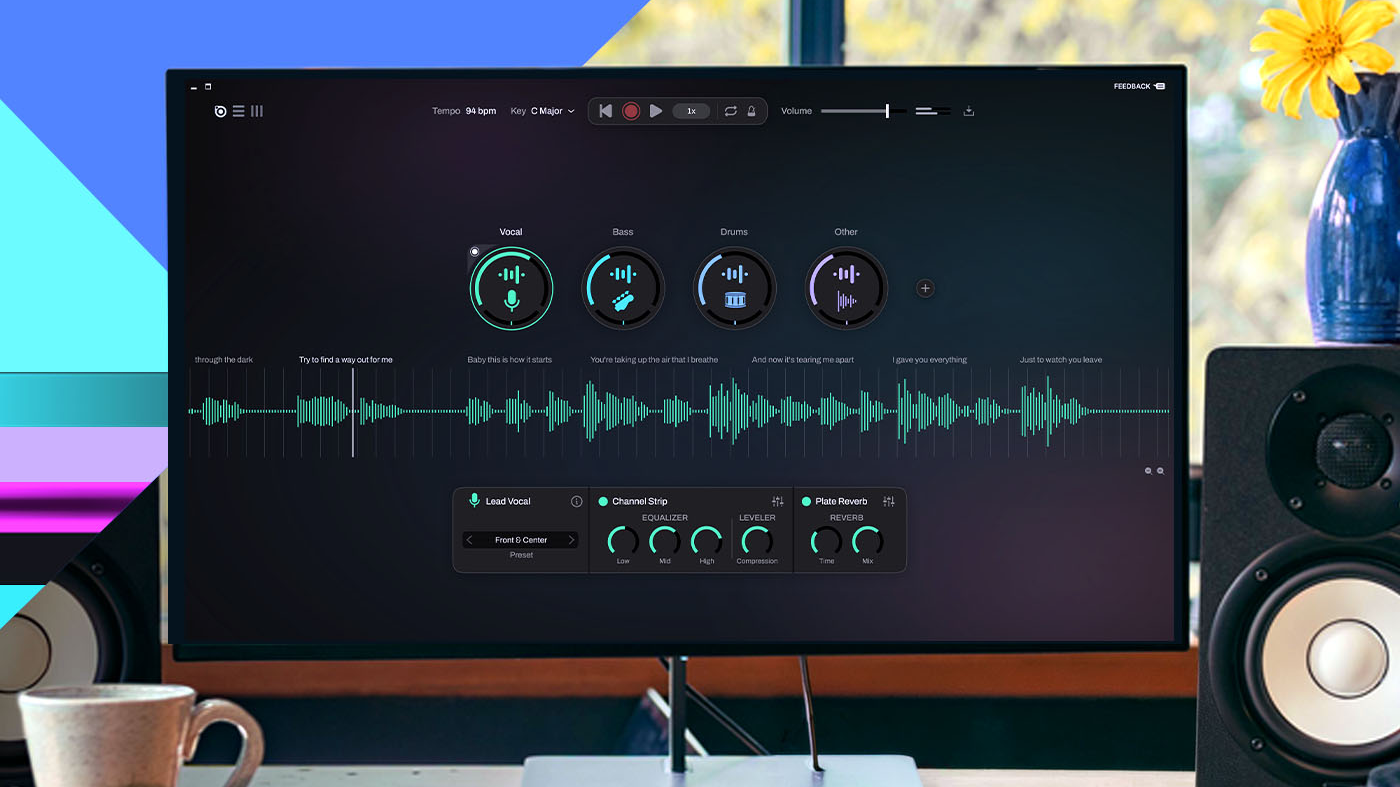
LALAL.AI and Neko Engineering have announced a partnership that puts stem separation inside a pocket-sized guitar rig. The device, called Neko, was shown by both companies at IBC 2026 in Amsterdam and is now open for pre-order. It combines an amp modeler, effects processor, DAW, stem splitter and recorder in one wireless unit. The Stem Splitter inside it is powered by LALAL.AI and separates a song into guitar, bass, drums and vocals in real time, on the device, with no companion app and no network connection. The announcement says the engine is the same one that powers local separation in LALAL.AI's desktop app and VST plugin, adapted to run within the memory and processing limits of embedded chips. A Tabs Converter turns a guitar stem into readable tabs, and a Time Machine feature records what you play into a timeline. Pre-orders are open, with shipping to backers scheduled to begin in April 2027. The full announcement is at Rekkerd.
Why this matters if you want a score out of a recording
Most stem separation today happens on a computer. You upload a file or run a plugin, wait, and get back four or more audio files. That workflow assumes you are at a desk, which is fine for transcription work and useless for the moment you are standing in a rehearsal room trying to hear what the bass player on the record actually played.
Putting the same class of separation on a chip inside a guitar rig changes the shape of that moment. You feed a song in over Bluetooth, microphone, USB or as a file, and the device splits it. You mute the guitar part and play it yourself. You slow a passage down and bring it back up. You convert the guitar stem into tabs. None of that requires a laptop, a queue, or a signal leaving the room.
For a guitarist learning parts by ear, that is the whole loop in one box. For a teacher standing next to a student, it is the difference between saying "listen to the second verse again" and actually isolating the second verse on the spot.
What it changes in practice
The interesting claim here is not that separation exists. It is where it runs. The announcement is explicit that the separation happens on Neko's own chip, and that some competing on-device implementations pair hardware with a phone app that does the actual processing. That distinction matters more than it sounds. If the phone is doing the work, the feature dies when the phone is not there, which is exactly when you want it.
The other change is that a guitar rig now treats separation as a native part of the product rather than an add-on. That is a licensing deal: LALAL.AI is supplying an engine that another company builds into its own hardware. If that model works, expect more devices to ship with separation baked in rather than bolted on.
Here is what it does not change.
It does not give you notation. Neko produces tabs from a guitar stem, on the device. That is a useful first pass for a guitar part, and it is not the same thing as a score you can hand to a pianist, a horn section or a rhythm section. It does not export MusicXML, and it does not export MIDI for your DAW. If you need a part that opens in MuseScore, Sibelius, Dorico or Finale, or a MIDI file you can edit in Ableton, Logic or Reaper, you still need a transcription step after the split.
It does not cover the instruments a full arrangement needs. The split is guitar, bass, drums and vocals. Piano, keys, strings and horns land in whatever is left over. A piano transcription of a busy mix still starts with a clean piano stem, and this device does not produce one.
It does not remove the ear. A guitar stem converted to tabs is a first draft. Fast passages, bends, slides, open strings versus fretted notes, capo positions and alternate tunings are all places where an automatic tab will be wrong or at least arguable. You still listen, and you still decide.
And it does not change the rights picture. A transcription or tab of a copyrighted song is a derivative work. The rules differ by country. If you plan to publish, sell or perform what comes out of a split, talk to the rights holder or your local licensing body first.
Our view
The trade-off is portability against depth. A pocket rig that splits a song on the spot is genuinely useful for a guitarist learning a part, and it is the wrong tool for producing a score. The two jobs overlap less than the marketing suggests.
The open questions are the ones the announcement cannot answer. How does on-device separation handle a dense mix, where the guitar is buried under reverb and doubled across two amps? How does it handle a clean single-coil part against a busy drum kit? How much does the conversion to tabs respect alternate tunings? Those are the tests that decide whether this is a practice tool or a novelty, and nobody has run them publicly yet.
We also want to see how the licensing model develops. LALAL.AI says this integration proves the engine can run inside someone else's hardware in real time with nothing sent over the network. If that holds up under load, it is a more interesting story than the guitar rig itself: separation as a component other companies buy, the way reverb and amp models are bought today.
Who should care. Guitarists who learn parts away from a desk, and teachers who want to isolate a part in front of a student, have a real reason to watch this. Producers and arrangers who need notation out of a recording do not, at least not yet. Their bottleneck is the transcription step, not the split.
What to do next
If you are working from a recording right now, the order of operations is the same whether the split happens on a chip or on a server: separate first, then transcribe. Separation is usually what makes a transcription of a busy mix usable, because it hands the transcription model one instrument instead of five.
You can split a mix into vocals, drums, bass and the rest on our pipeline, then transcribe the stem you care about. If you want to edit the result in a DAW rather than read it, run the same audio through the audio to MIDI converter. If you would rather see what other people have already worked out, Explore is a public library of shared transcriptions.
Teachers and schools often want a score for a specific arrangement rather than a single part. That is the case where a full transcription, edited by hand, still beats anything a device does on the fly. The help pages cover what to send and what comes back. For the shape of the offer rather than numbers, see pricing.